


Opinion from the Left
They say a picture is worth a thousand words. But a picture is also just a single data point.
On August 17, The Free Press (Lean Right bias) accused several major news outlets of publishing misleading photos of emaciated children and implying their appearances were due to a war-induced hunger crisis “without disclosing the complicated medical histories that help explain their stark appearances.”
The Free Press identified 12 Gazans with conditions including cerebral palsy and cystic fibrosis who appeared in reporting by outlets including the Associated Press (Left), New York Times (Lean Left), BBC (Center), CNN (Lean Left), NPR (Lean Left), and The Guardian (Left). While the outlets reported that all photo subjects suffered from malnutrition, in several cases, they also omitted the additional medical conditions that may have contributed to their gaunt appearances. All of these outlets later updated their stories with clarifying information — some before the Free Press report was published, and some after.
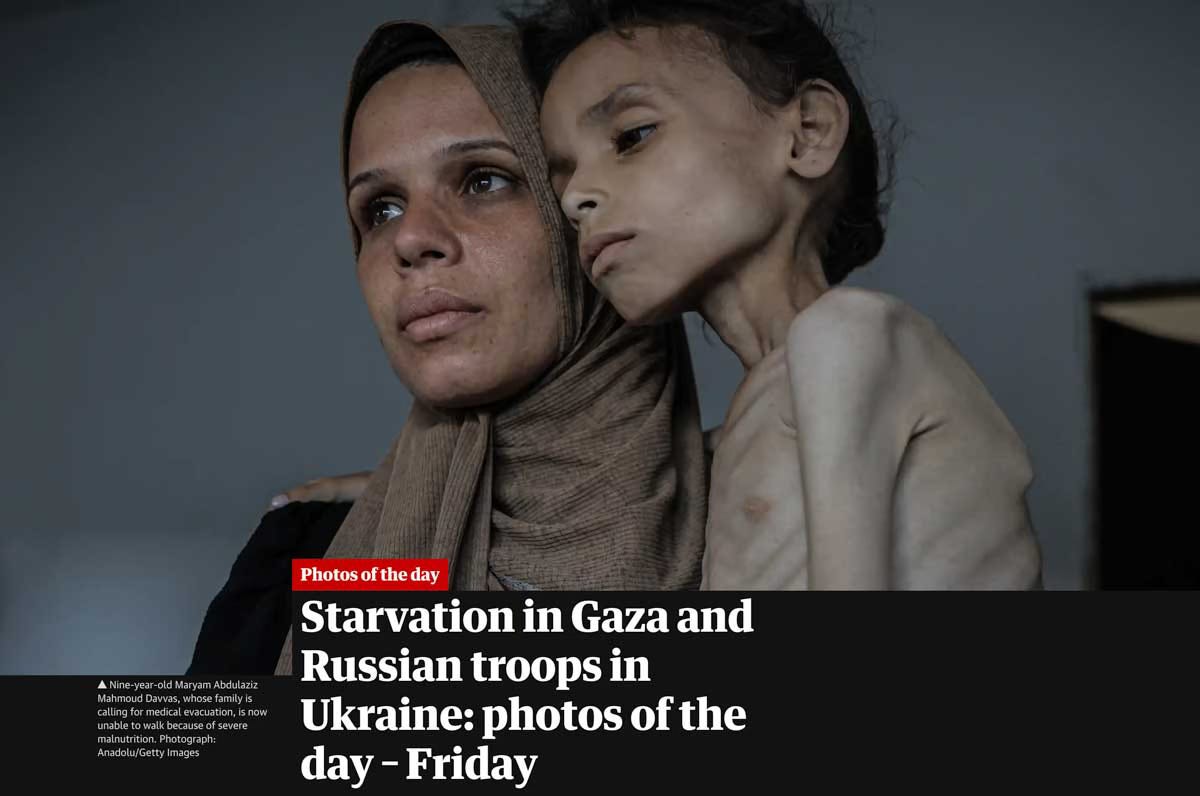
What should we make of this?
Photos serve a few different purposes in journalism. Mainly, they can be used as primary sources. For instance, a story about a specific crime might use a CCTV screenshot capturing the crime in progress. More commonly, and in this case, they can be used to illustrate a real phenomenon (the hunger crisis in Gaza) that’s too complex to be captured in a camera frame.
Not all illustrative photos are used responsibly. By putting these photos next to reporting about starvation in Gaza, journalists arguably imply these emaciated appearances are common among all Gazans, rather than rare outliers with pre-existing conditions. These outlets stretched the truth with their initial reports, and they did the right thing by updating them with appropriate context.
But it’s far more irresponsible to use photos to illustrate a version of reality that is flatly contradicted by the available objective evidence.
Does the Existence of Food in Al-Sahaba Market Disprove a Hunger Crisis?
On July 28, as the Israel Defense Forces (IDF) allowed Gaza aid to resume after a months-long prohibition, The Press Service of Israel, a.k.a. TPS-IL (Not rated), captured photos and videos of food for sale at al-Sahaba Market in Gaza City.
Other Israeli outlets republished the images. The Jerusalem Post (Center) described the market as “filled with fruit and featuring active vendors.” A headline from Israel National News (Not rated) explicitly cast doubt on the idea that starvation is widespread in Gaza.
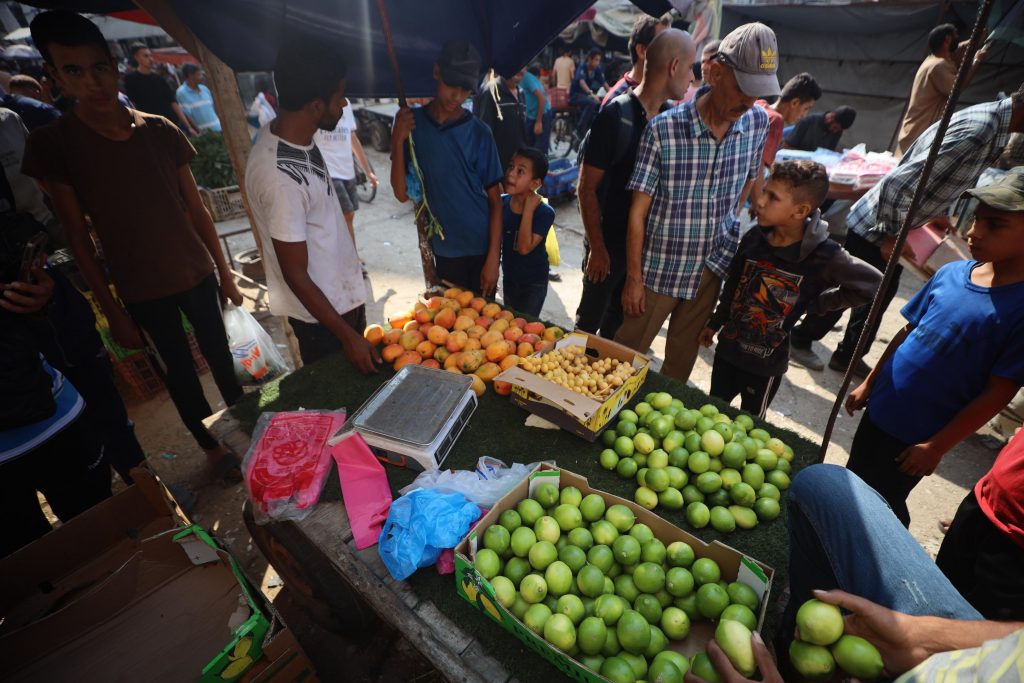
Meanwhile, Israel’s Foreign Affairs Ministry has used the footage in video ads — including one encountered by this author on YouTube, which declares, “There is food in Gaza. Any other claim is a lie.”
Needless to say, no serious news outlet has reported that there is literally zero food in Gaza. But more importantly, just because there’s food for sale in a single market in Gaza does not mean that a large swathe of the population is not starving. A quick look at the facts makes clear how these images could exist amid a serious hunger crisis.
For one thing, the only factual information we get from the videos and photos is that there was food on display at al-Sahaba Market on July 28. We don’t know how much food the market had in the days before. We don’t know how long the food lasted, or if it was restocked. We don't know how many Gazans could afford the food. We don’t know if other markets in Gaza had similar amounts of food.
Well, actually, we do have some information about those things from other sources. For instance, July 28 was one day after the resumption of aid deliveries into Gaza. It's quite reasonable to conclude that the market probably didn't have much food, if any, in the days before.
Also, a Palestinian in the market told TPS-IL, “Today I saw fruit for the first time in four months,” and multiple marketgoers said they couldn’t afford the food. As corroborated by the New York Times and others, food prices in Gaza have skyrocketed since the start of the war, particularly for fresh fruits and vegetables like those depicted in the footage.
Not to mention, a handful of clips from a single food market on a single day pale in comparison to the many videos of desperate Gazans pushing through uncontrolled crowds at aid sites, risking their lives for a small chance of securing food. But these images are no substitute for statistical evidence either.
So, Is There a Hunger Crisis in Gaza?
On August 22, the Famine Review Committee (FRC), an international expert panel tasked with maintaining the Integrated Food Security Phase Classification (IPC), released a report in which it declared a famine in Gaza City and surrounding areas. As NPR explained, the FRC applies this label to a given area when:
- at least 20% of its households face “an extreme lack of food that… leads to acute malnutrition and mortality;”
- “at least 30% of children under five suffer from acute malnutrition;” and
- “at least two of every 10,000 adults die each day from non-trauma causes.” (Measuring only those whose cause of death was starvation would leave out those whose hunger worsened their other medical problems to the point of fatality.)
This declaration has not been without controversy. As the Washington Free Beacon (Right) reported prior to the report’s release, the FRC is using a less precise measure in Gaza to assess acute malnutrition in children than is typical. The famine threshold for this alternative measure is 15% instead of 30%. Science.org (Not rated) pushed back on this narrative, pointing out that the alternative gauge has been in use since 2019 in other parts of the world, and an accurate reading of acute malnutrition is exceedingly difficult to obtain in an active war zone.
If you think the FRC is lowering the bar for Gaza, that’s your prerogative. But its assessment is widely considered a very high bar already. As The Guardian noted, humanitarian groups have previously criticized the FRC for an “overabundance of caution” in declaring famines.
Even the Free Press has praised the IPC’s robustness. Back in May, it published a piece by Michael Ames (Not rated) calling the IPC “data-driven,” “evidence-based,” and the “global gold standard for food security analysis.” The FRC had pushed back on earlier declarations of famine by other parties, and Ames used this as evidence against the existence of a hunger crisis in Gaza. He wrote that an FRC-declared famine “would have been a historic catastrophe.”
As of this writing on August 27, the Free Press has not covered the FRC’s confirmation of said historic catastrophe.
My Perspective
In the fog of war, confusion and conflicting information are unavoidable. To make things worse, both sides of the Israel-Hamas war have chosen strategies of obfuscation. Journalists need to recognize this reality and pursue the truth in spite of the warring parties’ attempts to hide it.
They also need to be mindful of the overall picture their reporting conveys. It’s not enough to report some truths and call out some lies; journalism must convey the whole truth of its subject.
To its credit, the Free Press ran a more balanced piece in July by Matti Friedman (Not rated) which criticizes not only Hamas, but the Israeli government and armed forces for manipulating information.
Friedman raises some strong arguments; while I believe Israel’s continued prosecution of the war is deeply unjust, I think the American left should take more seriously the evidence that Hamas deliberately puts Gazans in dangerous conditions and blurs the distinction between civilians and fighters to create obstacles for the IDF. (That’s mostly why I think a war with the aim of “eradicating Hamas” can never end, at least not without unthinkable acts.)
However, on the whole, it’s clear the Free Press has picked a side in what Friedman characterizes as an “information war.” Being composed of diligent journalists, it doesn’t contribute directly to the “blizzard of ideological fiction” — but there’s a pattern in how much effort it puts into dispelling those fictions. Photos that exaggerate the hunger impact of the war get front-page treatment and a follow-up pat on the back. Meanwhile, misleading video clips released by the IDF and picked up by Israeli news outlets get only a passing mention in Friedman’s piece.
There’s a similar pattern in which truths the Free Press chooses to amplify. Remember, they described a hypothetical FRC declaration of famine in Gaza as a “historical catastrophe” when it suited a pro-Israel argument. Now that it’s no longer a hypothetical? Crickets. That is a glaring omission of key information about this war.
News outlets on the left have also put out biased reporting on the war, as AllSides has covered. I don’t let them off the hook for that; if, like me, you want this war to end, we need to understand Hamas’ role in it as clearly as we do Israel’s. And we need to be aware that both Israel and Hamas would like for certain information to be amplified and certain other information to be downplayed. We should demand all information.
That said, left and center outlets like AP, Reuters, and Al Jazeera (Lean Left) are providing the world virtually all of its on-the-ground reporting of the war, despite Israel having banned foreign journalists from entering Gaza since the outset of the war in October 2023. These outlets deserve commendation despite their mistakes, and the Gazans who risk their lives to record the war deserve protection. Sadly, they're not getting it.
On Monday, the IDF struck a Gaza hospital twice, killing four journalists who contracted for news outlets including Reuters (Center) and AP — the latest in a long list of similar incidents. Each time, the IDF claimed these journalists were in the company of Hamas fighters, or themselves Hamas fighters, or carrying a camera for Hamas. But we must recognize the IDF has an incentive to cut off information flowing out of Gaza, and there’s neither the domestic nor international pressure to make them think twice.
Yet, in spite of so many obstacles, some truths are too big to be hidden. There is famine in Gaza.
Evan Wagner is a Product Manager at AllSides. He has a Lean Left bias.
Reviewed by Henry Brechter, Editor-in-Chief (Center) and Johnathon Held, News and Bias Analyst (Lean Right).

.jpg.webp)

