


Updated 6/24/25 at 2:47pm ET
A group of Senate Republicans led by Mike Lee (R-UT) proposed a revision to the “One Big, Beautiful Bill Act” – on which the Senate is preparing to vote – that would result in 2.2 to 3.3 million acres of federal land being sold for housing development over the next five years.
Many liberals and conservatives condemned the proposal, highlighting the rural and urban ideological biases beyond left and right. Additionally, critics argued the plan lacks transparency and is unclear about the parameters of intended sales.
Related: Beyond Left vs Right: 14 Types of Ideological Bias | AllSides
Lee claimed media on the left demonized his intentions. He argued, “The federal government owns 640 million acres of land, nearly a third of all land in the United States. The vast majority of that land has zero recreational value. Disposing of a fraction of 1% of that so that the next generation can afford a home is a common-sense solution to a national problem.” The proposal excludes the sale of national parks, monuments, and recreation areas.
Update 6/24/25: Lee announced major changes to the proposal following substantial bipartisan criticisms. The changes include a significant reduction in the amount of land for sale, the establishment of "freedom zones," and protections for farming and recreational purposes. Official plans were not publicized as of Tuesday morning. Here is what the initial proposal and responses looked like before the impending updates.
How Much Land is Being Sold?
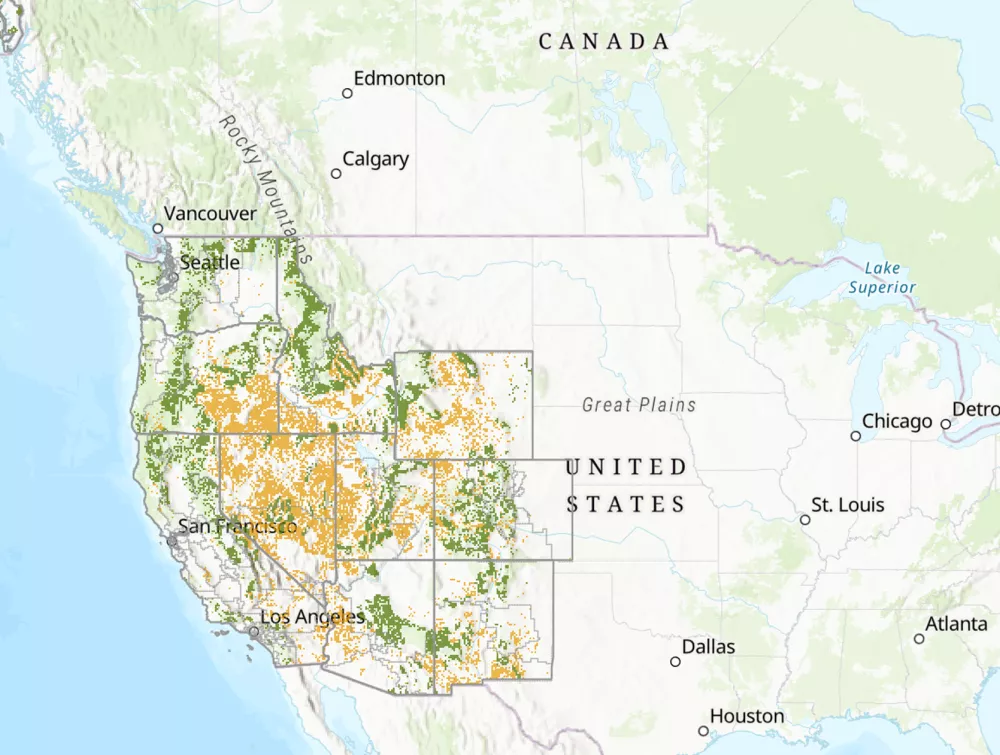
The bill would require the Forest Service (FS) and Bureau of Land Management (BLM) to identify between 2.2 and 3.3 million acres of land to be sold across 11 western states over the next five years. This equates to between 0.5% and 0.75% of both agencies’ shared public land. FS manages 193 million acres of land, while the BLM manages 245 million acres of surface land. More than 80 national park units sit adjacent to public lands managed by the BLM. Additionally, nearly 35 million acres of unprotected BLM land lie within 50 miles of a US national park, and about 50 million acres of BLM land fall within 25 miles of national or state parks.
States with public land up for sale are Alaska, Arizona, California, Colorado, Idaho, Nevada, New Mexico, Oregon, Utah, Washington, and Wyoming.
According to a fact sheet from the Energy and Natural Resources Department, the proposal aims to make federal land available for housing by prioritizing parcels near existing development and infrastructure, including those that are adjacent to built-up areas, suitable for housing, or difficult for federal agencies to manage. The Interior Department estimates the BLM controls roughly 1.2 million acres within a mile of population centers, plus another 800,000 acres within five miles. The FS manages over 1 million acres within a mile of such areas, much of which may be eligible for disposal.
Overall, about 250 million acres of public land would be eligible for sale. While the proposal says it excludes the sale of National Parks, National Monuments, National Recreation Areas and other protected wilderness areas, only about 13% of federal lands have these special designations.
Additionally, President Donald Trump’s Department of Agriculture announced plans in June – shortly after the proposal was released – to roll back protections for about 60 million roadless acres of the National Forest System.
Why People Support the Proposal
Some people – mainly on the right – agree with Lee’s claim that the sale of some public land is a small price to pay to avert an evolving housing crisis.
Opinion writers for Washington Examiner (Lean Right bias) wrote, “Three million acres sounds like a lot of land, but the federal government owns more than 640 million acres throughout the U.S., so the area designated would be less than half a percent of the total.” They pointed out that both Kamala Harris and Trump supported selling some federal land for affordable housing during their 2024 presidential campaigns. The writers also criticized environmental concerns surrounding the proposal, asserting, “If we want a vibrant society that builds things again, where families can afford a new home, we must not give in to the dishonest environmental activists.”
The Wall Street Journal (Lean Right) Editorial Board said, “Selling a small amount of federal land would raise revenue and spur development, so why are some Republicans trying to protect the government’s hoard?”
It wasn’t just media on the right, though. The Boston Globe (Left) published an opinion piece in May by George W. McCarthy, the president and CEO of the Lincoln Institute of Land Policy. McCarthy argued that public lands could play a key role in narrowing the gap between housing supply and demand if handled strategically. He wrote, “While the sheer amount of public acreage that appears to be at its disposal overall is impressive and exciting… taking a thoughtful approach to identifying optimal [and sustainable] locations for development is crucial.”
Why People Oppose the Proposal
Critics across the political spectrum say the bill prioritizes short-term profits over long-term environmental and public interests.
Seventy-one percent of Americans reportedly oppose the sale of national public lands, including 85% of Harris voters and 61% of Trump voters in 2024.
In addition to increasing land for housing development, the draft legislation from the Senate Energy Committee proposes boosting timber production in federally owned forests and generating over $15 billion by expanding oil, gas, coal, and geothermal leasing on public lands in Alaska and other regions, generating various concerns from environmentalists across the political spectrum.
A conservative writer for The Grand Junction Daily Sentinel (not yet rated) implied that Lee’s actions were unconservative and stated, “Many would often expect a conservative from Utah to understand the importance of hunting, fishing, agriculture, and recreation, but unfortunately, this is not the case.”
Benji Backer, author of “The Conservative Environmentalist,” argued that the proposal – which outlines land eligible for sale – unfairly lacks transparency. He wrote on X, “If you’re selling 3 million acres of OUR land, we deserve to know what’s being sold.”
Hayes Brown (Left) aligned with some conservatives in opposition to the proposal, in an opinion piece for MSNBC (Left). He asserted, “In practice, the sale of these lands would more likely be yet another boon to the wealthy in a bill already designed to facilitate a massive upward transfer of wealth… it would entail ‘disposing’ of untouched nature in favor of newly built McMansions and second homes that their wealthy owners can afford with their newly boosted bank accounts.”
Malayna J. Bizier is a News Analyst & Social Media Editor for AllSides. She has a Right bias.
Jessica Carpenter is a News & Social Media Editor for AllSides. She has a Center bias.
Reviewed by: Evan Wagner, Product Manager (Lean Left) and Henry A. Brechter, Editor-in-chief (Center)


.jpg.webp)
