


Robby Brod is a journalist. This was originally published on Open Secrets.
In 2024, campaign fundraising in federal elections was more nationalized than ever. Candidates for both the House and Senate continued a decades-long trend of relying less on donations from the voters they represent and more on contributions from donors across the country. The nationalization of campaign contributions, once a concern among elections experts, is now a defining feature of congressional campaigns.
An analysis of 2024 House and Senate campaign data reveals just how deeply this transformation has taken hold. From candidates in small states with limited donor bases to top congressional leaders with national profiles — and especially in competitive races in battleground states — non-local campaign contributions were ubiquitous.
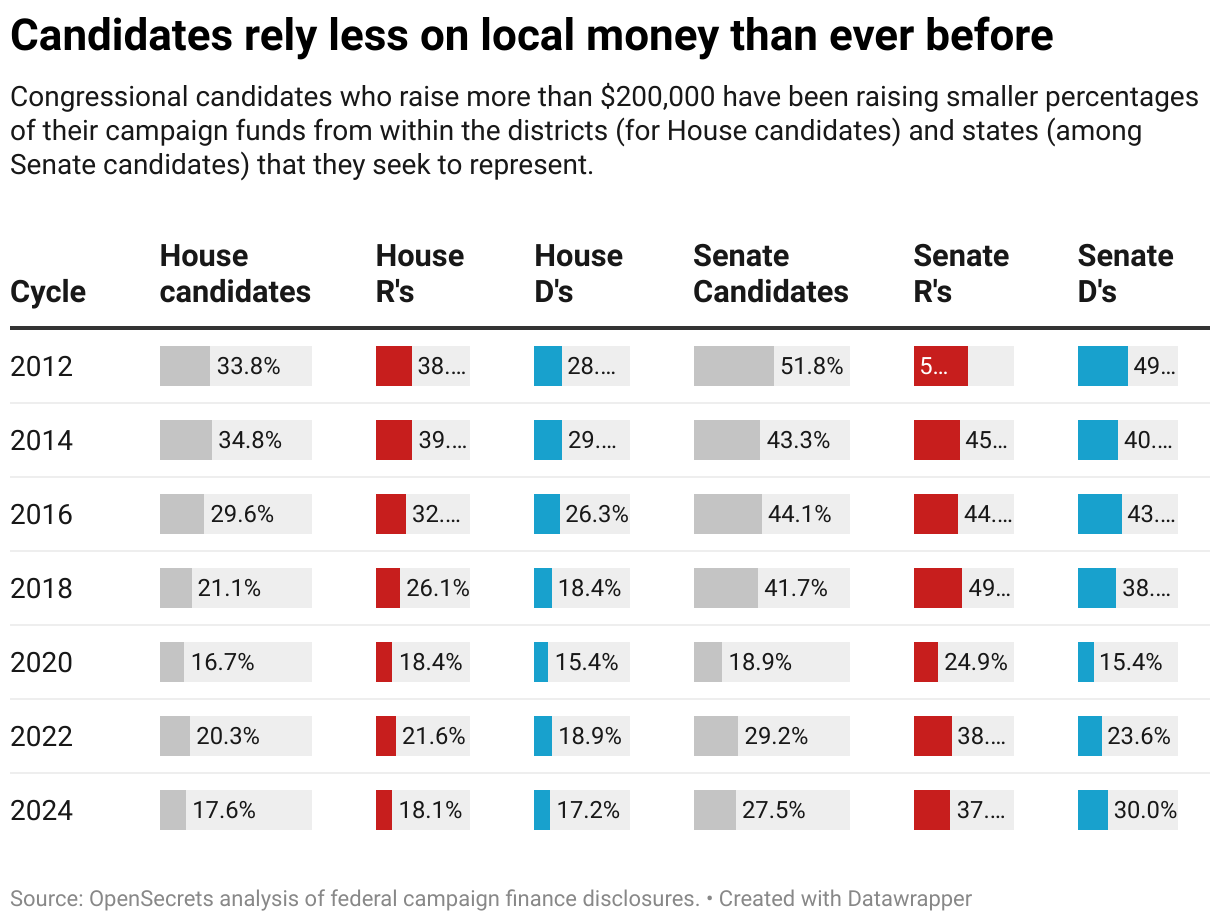
As congressional campaigns have become more nationalized, the share of money coming from within a candidate’s state or district has continued to fall — and in 2024, it reached the second-lowest levels ever recorded.
Just 17.6 percent of itemized donations to House campaigns came from inside the district, while Senate candidates raised only 27.5 percent from in-state donors. Only the 2020 election cycle saw lower shares of local fundraising, underscoring a long-term trend away from locally sourced campaign financing as candidates increasingly rely on national donor networks, online platforms and ideological contributors from outside their home turf.
The historic lows of 2020 help explain how these patterns accelerated: The Covid-19 pandemic forced campaigns to abandon in-person events and shift to digital fundraising, which resulted in record amounts of campaign dollars flowing through online campaign fundraising platforms like ActBlue and WinRed. This dramatic uptick in digital fundraising, combined with more national attention being paid to local races, coincided with a surge in out-of-state contributions. These figures remained high in 2024, which allowed candidates to pull in thousands of donations from across the country.
While such fundraising strategies help boost totals and expand reach, they also raise questions about local accountability and whether today’s campaigns are still financially rooted in the communities they aim to represent.
This article was originally published by OpenSecrets, a nonpartisan, nonprofit organization that tracks money in politics. View the original article.
.opensecrets-republished-article {
font-family: -apple-system, BlinkMacSystemFont, "Segoe UI", Roboto, "Helvetica Neue", Arial, sans-serif;
line-height: 1.6;
color: #333;
max-width: 800px;
margin: 0 auto;
padding: 20px;
}
.opensecrets-republished-article header {
margin-bottom: 30px;
}
.opensecrets-republished-article h1 {
font-size: 2em;
margin-bottom: 15px;
}
.article-meta {
color: #666;
font-size: 0.9em;
}
.article-meta span {
margin-right: 15px;
}
.republish-credit {
margin-top: 30px;
padding-top: 20px;
border-top: 1px solid #eee;
font-size: 0.9em;
color: #666;
}
.republish-credit a {
color: #0066cc;
text-decoration: none;
}
.republish-credit a:hover {
text-decoration: underline;
}
.jpg.webp)


